Americans are fond of referring to their country as "the greatest nation on earth". Until recently, I didn't believe any country deserved that description. But today I think there is a strong contender for the title.

China is the world's oldest living civilisation. It has recovered from over a century of colonial oppression and lifted its citizens out of poverty. As its growth continues, China is poised to become the world's largest economy and a technology leader that is second to none. By 2030, I believe it will be an indisputable fact that China is the greatest nation on earth.

I need to understand China, from a Chinese perspective. This is my journey.
Showing posts with label society. Show all posts

Saturday, 22 January 2022

In My Shoes - Scenes Of Life In China Through The Eyes Of Children

Australia's ABC TV presents a very nice 7-part documentary series made by the BBC about life in China, and each sub-ten-minute episode is narrated by a child from a different part of the country. The entire series takes just an hour, and it's well worth watching

Click on any episode link below:

Episode 1 (Ji Denghui of Xingping in Guangxi province):

This boy lives on an island close to the town of Xingping in the southern province of Guangxi (the poorer cousin of Guangdong to its east). The river Li seems to be a big part of the life of people there.

This episode and the next are based around the Karst mountains with their unique shape. These mountains feature on China's 20 Yuan note.

It seems to be a thing with tourists who visit this place to take a photo of the mountains along with the 20 Yuan note. Google's image search turns up plenty of such photos.

This place is now on my must-visit list. I'll probably go to Yangshuo town, though.

Episode 2 (Ma Tsu Tao of Yangshuo in Guangxi province):

This episode was my favourite. Something about the little girl's life in Yangshuo made me very fond of this town.

Her mother works as a teacher in her school, so they go to school together by scooter. It reminds me a bit of my childhood. My mother worked at my school, so she, my sister and I used to take an autorickshaw to school every morning.

This school seems to start pretty early (just after 0700), and students have breakfast in school. That must be fun.

The series is great for the little peeks it gives us into aspects of Chinese society. When class starts, it's not just the students who chant in slow chorus, "Good morning, miss!" as we used to do back in India. The teacher bows to the class first.

Then the students bow to the teacher.

Episode 3 (Wang Yu Shi of Lijiang in Yunnan province):

This episode is set in Yunnan province, and is probably unique because the boy who narrates it is from the Naxi ethnic minority.

The boy with his grandmother. There are some glimpses into how the Naxi community has its own script and cultural practices.

Episode 4 (He Weiqing of Chan'gou village in Yunnan province):

The little girl here comes from a less well-off rural family, and lives at her school during the term, only going back home during breaks.
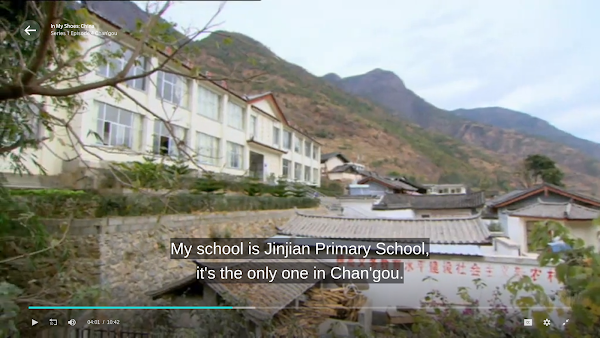
Yunnan province on the whole seems like a less developed part of China. This is the only school in the district.

The entire school only has 78 pupils.

Another little tidbit about Chinese culture. Unlike schools in other parts of the world where one sees a short and simple motto (usually Latin in Australia, Sanskrit in India), this one is somewhat more elaborate.

Chinese society places a lot of emphasis on education, one can see. It's also a common aspect of communist societies. The old USSR was also very big on education.

This school has among the smallest class sizes I have seen.

This is a personal bugbear of mine. I don't like the insidious messaging about girls finding maths hard. There seems to be a pervasive gender bias around this topic, and I don't know if this was a genuine sentiment expressed by the girl, or something contributed by the BBC. Media should make an explicit effort to combat this bias.

We get a glimpse of the girl's dormitory, since this is also a boarding school. There's a short scene of the school breaking for the Spring break, and the girl's father coming to the dormitory to pick her up. They then trek back to their home, which seems to be a long walk away.

Episode 5 (Qing Qing of Tian Chang city in Anhui province):
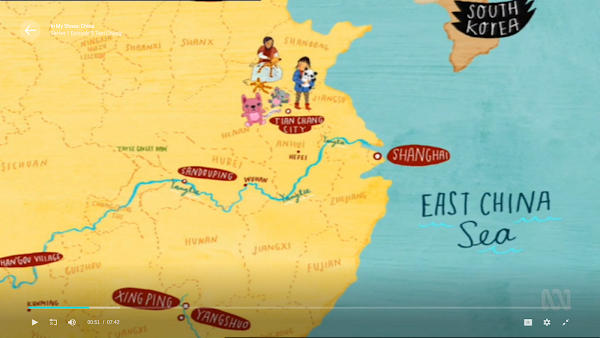
This is the first episode set in a city (Tian Chang in Anhui province in the East).

This was an interesting episode because the girl's mother works at a factory (one of author Leslie Chang's "Factory Girls").

The scenes at the factory are quite unique. It reminded me of my unique childhood on a University campus, which would have been quite different to the experience of most kids. It was nice to see the child wandering freely around the factory, even helping out with some of the chores.

We get a glimpse of how those "Made in China" toys are actually made.

Factory girls seem to be of all ages.

The little girl's mother doesn't work on the factory floor, but is in Sales. For a while, the girl and her mother were separated when the mother got her job in the city, and the girl had to be with her grandparents. But now, she has also moved to the city with her mother, and even has a place in the office to do her homework. I get the impression that China is more relaxed about workplace rules compared to Australia. The concern with systems, rules, risk, liability and insurance are major frictional forces in Western countries, in my opinion.

Nice to know that Winnie-the-Pooh isn't banned in China, as the rumours claim.

Episode 6 (Li Mengke of Sandouping in Hubei province):

Hubei province (meaning, literally, "North of the Lake") should be well-known to the world after Covid, since its capital is Wuhan. The little girl's town is on the Yangtze river, close to the famous Three Gorges Dam.

This girl lives with her grandparents, since her parents work in Guangdong, a 20 hour drive away. It seems to be a fairly common aspect of life in China that working-age people often have to work away from their hometowns, and children are brought up by grandparents instead.

This episode also talks about the Spring break, which is also the Chinese New Year. It's when workers go home to their hometowns to meet their families, and we get to see this from the other side, i.e., the perspective of the child who gets to see her parents after many months.

The girl and her grandfather doing festival shopping.

The family is finally together...

...and enjoys a traditional feast.
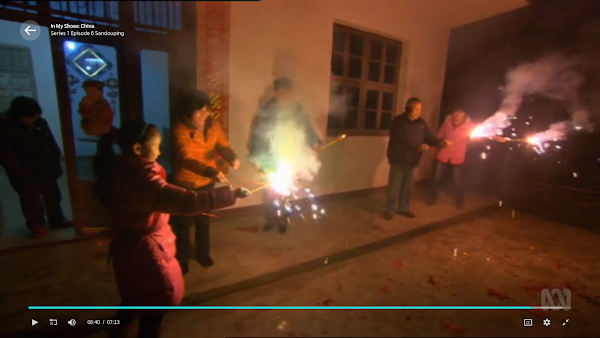
Fireworks are part of the festival, and the episode explains why. New Year in China is associated with a New Year Demon (Nian Shou), which eats children, but which can fortunately be frightened away by bright lights, noisy fireworks and the colour red (which is why red is considered an auspicious colour in China).

Episode 7 (Zhe Wen of Shanghai city):

This is the only episode set in a major metro. The little girl's life is remarkable for the number of different classes she attends outside of school. Chinese parents seem very dedicated about cramming their kids with every imaginable skill.

It was amusing to see kids darting through the school gates before they closed.

After school, the girl's mother takes her to music class by the Shanghai metro, and even carries her cello for her.
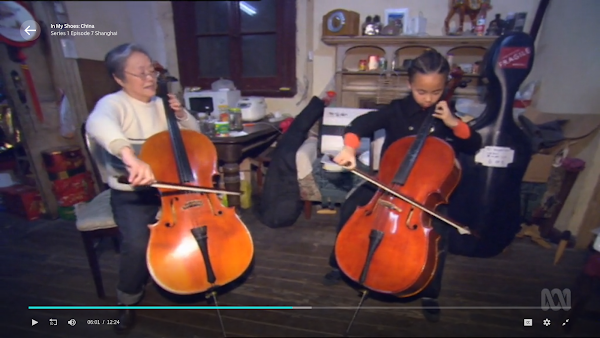
Music seems to be a compulsory part of a child's education in the Chinese community. Among Australian Chinese, I've heard that children need to learn not one but two instruments (usually the violin and the piano).

On Saturday, the girl attends two special classes. This one was interesting. It seems to be about assembling mechanical toys, somewhat like the Meccano sets we used to have in our childhood in India.

I'm happy to see there's no gender bias here.

And then there's maths class, of course.

Early preparation for the much-feared Gaokao, no doubt.

It's relentless. She has to attend classes on Sunday too! These seem to be closer home, since her dad takes her there on his bicycle.

English class.

I certainly hope China hasn't shut down this window to the world out of pique at the current Western propaganda onslaught.

And then there's calligraphy class, and this bit of cultural education rounds out what a child seems to learn.

Overall impressions:

I really liked this series. The episodes were short (less than 10 minutes each), but managed to pack in quite a bit. Viewers can learn a lot about life in China in just an hour overall. Geographically, although the episodes covered four provinces and a metro, they all seemed to be south-eastern provinces. There was nothing from the West, North, or Northeast of China. Anhui was the only province north of the Yangtze. I hope the BBC continues the series with more episodes. It was a great watch.

Tuesday, 4 January 2022

Chinese Lead Characters In Mainstream Western Cinema - A Review Of Netflix Movies "Love Hard" And "The Half Of It"

[Warning: Plot spoilers galore!]

After years of watching ethnic minorities caricatured in Hollywood movies and TV shows, it was a refreshing pleasure to see a couple of movies in quick succession where one of the main leads is Chinese, and further, to see them portrayed entirely positively.

The movies themselves, while watchable, are not superlative. I'd give them each a 3.5 out of 5. They have their flaws, but their differentness alone makes them worth a watch.

Love Hard (directed by Hernán Jiménez) is a story of a Caucasian American woman (played by Nina Dobrev) who meets who she thinks is a Caucasian American man online through a dating app. He's smart, well-read and witty, and seems quite sorted too, so she impulsively takes a trip across the country to be with him for Christmas. Which is when she gets a shock. The guy (played by Jimmy O Yang) turns out to be Chinese, not Caucasian. Of course, he's a second- or third-generation Chinese-American, and everything else about him is genuine, except for his profile pic. He wasn't getting any interest from girls when he had his own picture up, so he swapped it for one belonging to his Caucasian friend, and then things began to look up.

There's some credibility-stretching stuff in the plot after that, but the long and the short of it is that the woman finally realises that this thoroughly decent Chinese guy is the one for her after all.

Minor plot point: The movie takes its name from the fact that the male lead's favourite Christmas movie is "Love, Actually", and the female lead's is "Die Hard". (Yes, I know. Whether "Die Hard" is in fact a "Christmas movie" is one of the big topics of discussion between the characters.)

The Half Of It (directed by Alice Wu) is an even less conventional movie. The main lead (played by Leah Lewis) is a Chinese girl, a high school senior in a small, all-white American town. She endures plenty of casual racism and mild bullying, but the other kids need her, ironically enough, for her superior English skills. She makes some pocket money writing their essay assignments for them.

The romantic angle here is very different, though. There is a love triangle, but since director Wu is herself lesbian, that makes the triangle a bit different. There isn't a clear resolution of who pairs up with whom at the end of the movie, but it's not a tragic ending either. (I wouldn't give it a 3.5 out of 5 if it was.) It's what can be called a "coming of age" movie because the characters grow and learn over the course of the story.

Incidentally, both movies are set in small American towns (Lake Placid in New York state, and Squahamish in Washington state). If that's what small-town society is like, I'm glad I'm a big-city person!

What I liked about both movies was the portrayal of the lived reality of ethnic minority people in Western countries. We're normal, not fringe. In many ways, we're not just normal, but positively high-functioning, and our families are typically not broken or dysfunctional, but fairly cohesive, and singlemindedly oriented towards the education and upward socio-economic progress of the children.

In other words, we're different but we're all right, and that's what these two movies bring home. I know, I'm Indian and these characters are Chinese, but with my experience of living in a Western society, I identified quite strongly with these characters.

Thursday, 30 December 2021

Indian Social Media Influencers In China - Vlogging As A Means To Combat 'Ve Log'ing (Othering)

I'd like to ring in the New Year on a positive and hopeful note.

It's no secret to those who know me that I would like to see India and China come closer together. Politically, I would like the two countries to be trusted allies and to face a hostile world together (No prizes for guessing which antagonistic power bloc I'm referring to). On a people-to-people basis, I would particularly like for Indians to shed their negative attitudes and prejudices towards the Chinese, and to recognise them as people like themselves.

I'm therefore gratified to see popular Youtube channels by Indian vloggers living in China and married to Chinese people. They're not celebrities, just ordinary people, and that's what makes their stories so interesting and relatable. The detailed documentation of their daily lives gives their audiences an intimate look into life in China, and the featured interactions with family members and friends provide an interesting picture of contemporary Chinese society.

I've selected two in particular. One is a guy from Himachal Pradesh called Ravi Bhardwaj, who seems to be a professional Yoga teacher. The other is a lady from Rajasthan called Ruchi (surname and profession unknown). Both have been living in China for a few years, and are married to Chinese people. Each couple has a young child.

Top: A scene from "Ruchi in China". Bottom: A scene from "Indian in China".

Ravi Bhardwaj mainly speaks in Hindi. His channel is rather unimaginatively called "Indian in China".

Here's a sample videoclip from his channnel:

Ruchi's channel is called "Ruchi in China" (a slight improvement over "Indian in China"). She speaks in a mixture of Hindi and English.

This is a sample videoclip from her channel:

The word "vlog" in this context reminded me of the Hindi वे लोग ve log ("those people"). Indians tend to know little about the Chinese, and their (negative) attitudes towards Chinese people are overly influenced by political events such as the simmering border dispute between the two countries and the prevalent narrative on the Indian side that portrays the Chinese as treacherous and untrustworthy.

Having lived in Australia for almost a quarter century now, and having made many good Chinese friends, I can see that the Indian view of the Chinese is baseless and highly distorted. The "othering" of the Chinese people can potentially be counteracted by channels like these, where Indian viewers can be introduced to ordinary Chinese people through the eyes of other Indians like themselves.

It's entirely possible, by the way, that these channels are not completely independent individual initiatives but receive some degree of support from the Chinese government. The amount of travelling these people do suggests that there is a hidden source of funding and direction. However, I don't see that as a disqualification. Cultural outreach is fair play, and it's in a good cause to boot. The stream of images, voices and situations that Indian viewers get exposed to is far preferable to the information vacuum in which a one-sided mainstream media narrative has been playing out all these years. I believe that India today is sleepwalking into a defence and foreign policy nightmare thanks in large part to media brainwashing about China that sabotages trust before it can even take root. If at least some Indians begin to shake off that conditioning and start to explore their neighbouring country for themselves, it could lead to a more peaceful and cooperative tomorrow.

And so, as New Year's Eve approaches, I raise a toast to these vloggers and say 干杯! gānbēi! ("Cheers!"). The bridges they're helping to build are no less important than the steel-and-concrete ones of the BRI.