Americans are fond of referring to their country as "the greatest nation on earth". Until recently, I didn't believe any country deserved that description. But today I think there is a strong contender for the title.

China is the world's oldest living civilisation. It has recovered from over a century of colonial oppression and lifted its citizens out of poverty. As its growth continues, China is poised to become the world's largest economy and a technology leader that is second to none. By 2030, I believe it will be an indisputable fact that China is the greatest nation on earth.

I need to understand China, from a Chinese perspective. This is my journey.

Thursday, 30 December 2021

Indian Social Media Influencers In China - Vlogging As A Means To Combat 'Ve Log'ing (Othering)

I'd like to ring in the New Year on a positive and hopeful note.

It's no secret to those who know me that I would like to see India and China come closer together. Politically, I would like the two countries to be trusted allies and to face a hostile world together (No prizes for guessing which antagonistic power bloc I'm referring to). On a people-to-people basis, I would particularly like for Indians to shed their negative attitudes and prejudices towards the Chinese, and to recognise them as people like themselves.

I'm therefore gratified to see popular Youtube channels by Indian vloggers living in China and married to Chinese people. They're not celebrities, just ordinary people, and that's what makes their stories so interesting and relatable. The detailed documentation of their daily lives gives their audiences an intimate look into life in China, and the featured interactions with family members and friends provide an interesting picture of contemporary Chinese society.

I've selected two in particular. One is a guy from Himachal Pradesh called Ravi Bhardwaj, who seems to be a professional Yoga teacher. The other is a lady from Rajasthan called Ruchi (surname and profession unknown). Both have been living in China for a few years, and are married to Chinese people. Each couple has a young child.

Top: A scene from "Ruchi in China". Bottom: A scene from "Indian in China".

Ravi Bhardwaj mainly speaks in Hindi. His channel is rather unimaginatively called "Indian in China".

Here's a sample videoclip from his channnel:

Ruchi's channel is called "Ruchi in China" (a slight improvement over "Indian in China"). She speaks in a mixture of Hindi and English.

This is a sample videoclip from her channel:

The word "vlog" in this context reminded me of the Hindi वे लोग ve log ("those people"). Indians tend to know little about the Chinese, and their (negative) attitudes towards Chinese people are overly influenced by political events such as the simmering border dispute between the two countries and the prevalent narrative on the Indian side that portrays the Chinese as treacherous and untrustworthy.

Having lived in Australia for almost a quarter century now, and having made many good Chinese friends, I can see that the Indian view of the Chinese is baseless and highly distorted. The "othering" of the Chinese people can potentially be counteracted by channels like these, where Indian viewers can be introduced to ordinary Chinese people through the eyes of other Indians like themselves.

It's entirely possible, by the way, that these channels are not completely independent individual initiatives but receive some degree of support from the Chinese government. The amount of travelling these people do suggests that there is a hidden source of funding and direction. However, I don't see that as a disqualification. Cultural outreach is fair play, and it's in a good cause to boot. The stream of images, voices and situations that Indian viewers get exposed to is far preferable to the information vacuum in which a one-sided mainstream media narrative has been playing out all these years. I believe that India today is sleepwalking into a defence and foreign policy nightmare thanks in large part to media brainwashing about China that sabotages trust before it can even take root. If at least some Indians begin to shake off that conditioning and start to explore their neighbouring country for themselves, it could lead to a more peaceful and cooperative tomorrow.

And so, as New Year's Eve approaches, I raise a toast to these vloggers and say 干杯! gānbēi! ("Cheers!"). The bridges they're helping to build are no less important than the steel-and-concrete ones of the BRI.

Wednesday, 29 December 2021

An Apt Near-Homophone - 1 (Wolf Warrior Actor 吴京 Wú Jīng And The Word For Armed Police 武警 Wǔ Jǐng)

I stumbled upon a sentence that referred to the armed police, and found that the word was 武警 Wǔ Jǐng.

Something about it sounded very familiar, so I looked up the name of the main lead and director of the Wolf Warrior movies.

Sure enough, it was a close homophone, only differing in tone - 吴京 Wú Jīng.

How about that? A guy who plays a commando has a name that sounds like "armed police". [It would have been even better if 吴京 Wú Jīng had played the role of Captain Xing Kelei in You Are My Hero, since that character was a SWAT police officer.]

I'm sure I'll come across many more such examples, so I'm making this post the first of a series.

Tuesday, 28 December 2021

The Thrill Of Being Able To Read Chinese "In The Wild"

One of my major pastimes nowadays is watching videos on China's High Speed Rail. I've lost "track" of the number of videos I've watched. I find them hypnotically soothing. Call me a nerd, but infrastructure development is a topic that gives me enormous joy.

This one on the Beijing-Shanghai high-speed rail link is one of my favourites. It's from Russia Today, and unlike the mostly fault-finding slant of typical Western media reporting on China, the tone of this documentary is refreshingly positive.

This video on the building of the Nairobi-Mombasa rail link in Kenya is another great one. China is making a real difference to the developing world, notwithstanding the smear campaigns on "debt trap diplomacy" (which have been debunked, by the way.)

Another of the videos I watched recently showed how rail tracks are actually laid. Previously, the process was manual, and could only lay 500 m of track every day even with scores of workers. Nowadays, with the process semi-automated, 2 km of tracks can be laid a day with only 20 technicians.

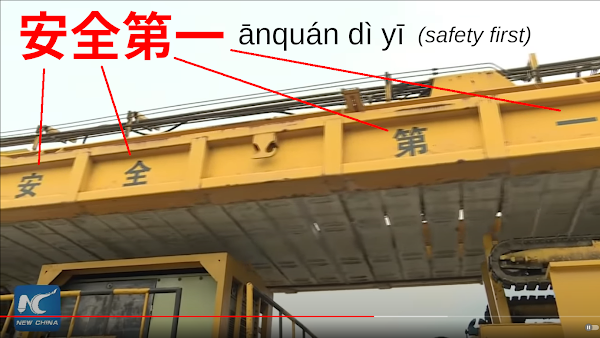
As the camera panned over the scene, I saw some Chinese characters come into view on the screen and almost subconsciously read them aloud - 安全第一 ānquán dì yī ("Safety first").

Such a thrill! I wasn't expecting to be able to make sense of anything, since most of the text I had seen until that point had a large number of unfamiliar characters. This just crept up on me, and I was myself taken aback that I could make sense of it at once.

[You may recall from a previous post that the character 安 ān means "safe", and the ideograph has the glyph 女 nǚ ("woman") under a roof. "Woman under roof" means "safe" in Chinese. That's cute and sad at the same time. The character 一 yī is probably the simplest Chinese character to learn, and means "one". 第一 dì yī means "first".]

Saturday, 25 December 2021

OCD Rant - 1 (下 Xià And 上 Shàng)

Chinese is a remarkably logical and consistent language, perhaps the best-behaved of all the languages I've studied.

Yet there are a few quirks here and there that irritate me, and I'll document those as I go along.

The first one is about 下 xià (down) and 上 shàng (up).

下 xià is nice and logical. There's a frame of reference - a horizontal baseline and a vertical "wall", and then there's a downward stroke that unambiguously denotes "down".

So far, so good. Let's now see what the Chinese character for "up" is.

It's 上 shàng.

OK, it's got the horizontal baseline, and it's at the bottom. Very good. It also has the vertical "wall". Excellent. Now for the upward stroke, right?

Oh no, how disappointing! It's a horizontal stroke, not an upward stroke. Now this is going to irritate me throughout my life whenever I transact in Chinese. Part of my mind is going to keep striking at that horizontal stroke from below in a vain attempt to get it to point upwards.

And the tone could have been upwards too (sháng).

This is what I think it should have been:

I don't think I'm being unreasonable in my expectation. You know what the Chinese word for table-tennis is, right? It's 乒乓 pīngpāng ("ping-pong"). Notice how the two characters are almost exactly the same, but the stroke below is leftwards for pīng and rightwards for pāng?

Why not do that for "up" and "down" then?

Grrr!

Monday, 20 December 2021

Why BUPA Needn't Have Been Afraid Of Biting The Wax Tadpole

We've all heard the apocryphal story of how, when Coca-Cola first went to China, the Chinese characters they used to spell the brand name turned out to mean "Bite the wax tadpole". Thereafter, the company changed the Chinese rendering of their brand name somewhat (to 可口可乐 kě kǒu kě lè), which means "let the mouth rejoice", or literally "can mouth can happy".

Recently, while watching a Chinese movie, I heard one of the characters say, "I'm not afraid", and this gave me a terrific idea.

[Aside: That movie ("A Beautiful Life") was a tear-jerker, by the way. Don't watch it. I made the mistake of thinking it was a rom-com and was blindsided by the unending series of bad things that happen to good people. I like movies where bad things happen to bad people. Note to self - never watch movies with unusually cheery titles.

On second thoughts, the movie wasn't actually that bad. Maybe you might like it. But keep a tissue box handy.]

What the character said in Mandarin was, "我不怕 wǒ bù pà", literally "I not afraid".

I immediately thought of the insurance company BUPA (originally an acronym for British United Provident Association).

Why, BUPA could just go to China without changing anything about their brand name. Isn't "Not afraid" a terrific name for an insurance company?

Afraid of risk? Buy a policy from the Not Afraid insurance company and you don't need to be afraid anymore.

But as my research showed, BUPA in China is known by a different set of characters - 保柏 bǎo bǎi. 保 bǎo means "insurance", which is not bad, but 柏 bǎi means "cedar" or "cypress", which doesn't mean anything related to insurance.

I wonder why they didn't just go with that.

[Whenever I start learning a foreign language, the wordplay puns popping up in my head give me lots of ideas for creative ad copy, such as my idea for a Bessemer ad in German: "Gut. Besser. Bessemer." (Good. Better. Bessemer.) Ad agencies should hire me as a creative consultant.]

Saturday, 20 November 2021

High-Speed Rail - China's Secret Weapon In The Economic Race

Much has been written about China's economic miracle. Lifting hundreds of millions of people out of poverty into the middle class in a single generation is a feat unprecedented in human history. The recent claim of having eliminated extreme poverty, if valid, is another remarkable milestone.

China continues to grow, and its current efforts to address the inequalities created by its past decades of uneven growth are worth watching. If successful, it would be a model worth emulating by the rest of the world, especially since the failures of both Communism and Capitalism have by now become obvious. "Socialism with Chinese characteristics" may be the economic model of the future.

It's a well known fact that over the past forty years since Deng Xiaoping's economic liberalisation, the provinces on China's eastern seaboard have developed at a much faster pace than the interior. The inequalities in wealth between urban and rural regions, and between coastal and interior provinces, have become a source of potential social conflict, one which the Chinese government is anxious to address. The Belt and Road Initiative is a means to provide better connectivity to interior provinces and thereby spur their development over the next thirty to forty year period. As this wonderfully insightful article by the Lowy Institute describes, there are several drivers, both internal and geo-economic, for the BRI, and if that initiative succeeds, it would have solved more than one problem at the same time.

As one who has studied China with great interest over the past few years, I believe that a crucial element of the country's development strategy is a certain technology, one that has hitherto never been deployed on such a scale anywhere in the world.

That technology is high-speed rail (HSR), and the Chinese government is betting on the multiplier effect that it will have on its economy.

Upon some analysis, I believe this expectation is justified. I created this simple chart to explain why.

There has traditionally been a speed-economy trade-off in the transport sector. Airplanes can get people and goods from place to place faster than any other mode of transport, but air travel is not cheap. At the other end of the scale, trains (and other modes of bulk surface transport) are affordable, but take much longer to connect places together.

Economists often draw a line to indicate the trade-offs inherent in a given portfolio of choices. In investment finance, such a line is called an "efficient frontier". In this chart of the transport sector, the efficient frontier could be thought of as representing a certain generation of technology.

What high-speed rail does is shift the efficient frontier outwards. High-speed rail is emphatically not on the old efficient frontier defined by the existing options of surface and air transport. High-speed rail is much faster than conventional surface transport, and much cheaper than air transport. While it's not quite the best of both worlds (i.e., as fast as air transport and as cheap as conventional rail), it is still a sufficient advancement to represent the next generation in transportation technology, one whose enhanced efficiency can rejuvenate slowing economic growth.

[Even this can change in the near future. The first-generation HSR 和谐号 héxié hào (Harmony) was capable of 350 kmph (operating speed 280 kmph). The second generation 复兴号 fùxīng hào (Rejuvenation) touched 420 kmph (operating speed 350 kmph). Future generations of HSR will probably start to approach aircraft speeds, and at far lower costs. High-speed rail would then be clearly superior to air travel with no trade-off at all.]

I believe that thanks to the aggressive rollout of high-speed railway lines throughout the country (a planned doubling of track length by 2035), the Chinese economy, far from slowing down, is going to continue to grow at a high rate for many years into the future. The less developed interior provinces, specifically Xinjiang, Tibet, Gansu, Inner Mongolia, Ningxia, Qinghai, Sichuan and Yunnan, which have hitherto not had high-speed rail connectivity, will see a boost to their economic growth.

If I were a student of economics wishing to do a doctorate in the area of developmental economics, I cannot think of a more exciting topic than the study of how high-speed rail acts as an economic multiplier to spur growth, and additionally, as a means to balance that growth by pulling far-flung regions into a tighter economic sphere.

High-speed rail is China's secret weapon that can enable it to leapfrog the West in prosperity within 10 to 15 years. The technology has the potential to (1) sustain China's breakneck pace of growth and avoid the "middle-income trap", (2) alleviate the imbalance in regional development and solve the problem of widening inequality that other countries are struggling with, and (3) make China a much more efficient and competitive economic engine, entrenching it in every other's nation's economy.

谢谢, 多邻国! Xiè Xie, Duō Lín Guó! (Thank You, Duolingo!)

I started learning Mandarin through Duolingo on 21 June 2021. Almost exactly 5 months later, on 20 November 2021, I completed all 88 lessons in the course, and 6 levels in each lesson.

Thank you, Duolingo! It's been an incredible learning experience, and I'm immensely grateful.

What next?

Well, I'm going to keep practising the lessons on Duolingo. The spaced repetition algorithm used by the app is a scientifically proven way to get a language into one's long-term memory, so this would be a great safety net to ensure I don't forget what I've learnt.

Of course, I have a few other resources that I will now pay more attention to, to continue to progress with my language learning. Du Chinese is an obvious one. I haven't been spending enough time on Du Chinese for a while, since Duolingo has been taking up about 2 hours of my time every day. With that effort easing up, I can devote more time to Du Chinese and to other online resources that I find on the web. I will post about any interesting ones I find as I go along.

One other interesting thing I've done is download the full set of words that Duolingo covers in its course. Some good souls have made this publicly available as a spreadsheet here.

Being an IT person with some database skills, I loaded this word list into a PostgreSQL database on my computer. The following steps may be useful to anyone who wants to slice and dice the data in ways that a simple spreadsheet cannot do.

create table t_temp
(
hanzi varchar(100) not null,
pinyin varchar(100) not null,
toneless_roman varchar(100),
meaning text
);

The PostgreSQL command to load a CSV-formatted spreadsheet with four columns into the above table looks like this (assuming one has saved the spreadsheet into a CSV file with semicolons as delimiters instead of commas).

\COPY t_temp from t_temp.csv CSV HEADER DELIMITER ';';

Once the data is loaded, here's the neat thing you can do. Use the column 'toneless_roman' to hold the romanised pronunciation of each word - without the diacritical marks that represent the tones. I'll show you why in a moment.

begin transaction;

update t_temp set toneless_roman = pinyin;

update t_temp set toneless_roman = replace( toneless_roman, 'ā', 'a' );
update t_temp set toneless_roman = replace( toneless_roman, 'á', 'a' );
update t_temp set toneless_roman = replace( toneless_roman, 'ǎ', 'a' );
update t_temp set toneless_roman = replace( toneless_roman, 'à', 'a' );

update t_temp set toneless_roman = replace( toneless_roman, 'ē', 'e' );
update t_temp set toneless_roman = replace( toneless_roman, 'é', 'e' );
update t_temp set toneless_roman = replace( toneless_roman, 'ě', 'e' );
update t_temp set toneless_roman = replace( toneless_roman, 'è', 'e' );

update t_temp set toneless_roman = replace( toneless_roman, 'ī', 'i' );
update t_temp set toneless_roman = replace( toneless_roman, 'í', 'i' );
update t_temp set toneless_roman = replace( toneless_roman, 'ǐ', 'i' );
update t_temp set toneless_roman = replace( toneless_roman, 'ì', 'i' );

update t_temp set toneless_roman = replace( toneless_roman, 'ō', 'o' );
update t_temp set toneless_roman = replace( toneless_roman, 'ó', 'o' );
update t_temp set toneless_roman = replace( toneless_roman, 'ǒ', 'o' );
update t_temp set toneless_roman = replace( toneless_roman, 'ò', 'o' );

update t_temp set toneless_roman = replace( toneless_roman, 'ū', 'u' );
update t_temp set toneless_roman = replace( toneless_roman, 'ú', 'u' );
update t_temp set toneless_roman = replace( toneless_roman, 'ǔ', 'u' );
update t_temp set toneless_roman = replace( toneless_roman, 'ù', 'u' );

commit;

Now you can run neat queries like this, which shows you all words that are pronounced "shi", whether the exact tonal pronunciation is shī, shí, shǐ or shì.

And this query is even more useful, because it can show you all words that contain any variant of "shi".

I'm going to be spending a lot of time mulling over the words I've learnt through Duolingo, and quite a bit of that rumination is going to involve SQL queries on these four columns to discover the semantic connections between words. In spite of its tremendous usefulness, Duolingo only provides the main meaning of each word, not its etymology or the literal meanings of compound words. I've posted earlier about some of the fascinating meanings I've discovered, and I'm sure my SQL database will help me discover many more.

Best of all, my database will continue to grow even beyond the vocabulary provided by Duolingo, and I hope to use this as a learning aid indefinitely.

I will post about all the insights I gain from my explorations in this blog, of course.

But for now, 非常感谢,多邻国 fēicháng gǎnxiè, duō lín guó ("Thank you very much, Duolingo").